
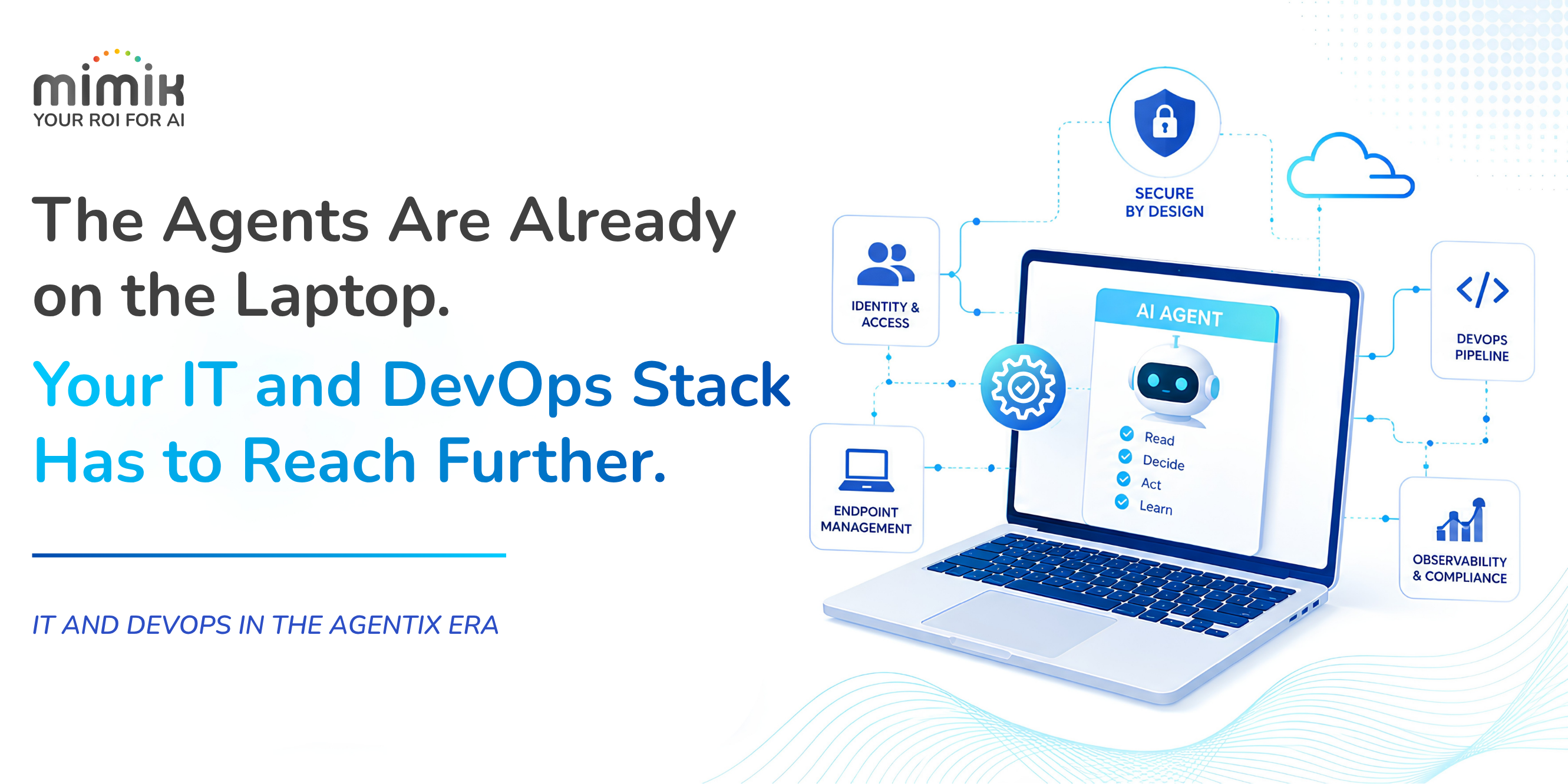
The Agents Are Already on the Laptop. Your IT and DevOps Stack Has to Reach Further.
Why the existing IT and DevOps stack does not reach the agent runtime, where the gap lives in your architecture, and what closes it without ripping out anything you built.
An open-source AI agent crossed 134,000 GitHub stars before most procurement teams had heard its name. It is installed on employee laptops today. It reads their email, drives their browser, executes shell commands, and runs continuously in the background. Your firewall does not see it. Your VPN does not protect against it. Your identity stack does not authenticate it. Your SIEM cannot describe what it does.
This is not a hypothetical from a Gartner deck. This is your current attack surface.
And it does not stop at the laptop. The same gap runs through every device the enterprise operates: phones, controllers, robots, vehicles, gateways, servers. The laptop is the first example because the laptop is the most visible. The architectural problem is the same on every endpoint.
The IT and DevOps stack inside every enterprise was built over a decade of patient investment. It enrolls devices, authenticates users, authorizes access, deploys applications, monitors traffic, and audits compliance. It is intact and it is necessary. It is also architecturally incomplete for the era that just arrived. The agents your employees are running today operate outside every control point your stack was designed to enforce, and they take real actions, against real systems, on real corporate data.
This post is for the leaders accountable for that gap: the CIO, the CISO, the CTO, Platform Engineering, DevOps, SRE, and the developers themselves. It names the stack you built, names what just arrived on top of it, names why current controls cannot reach the new layer, and shows where the gap closes. The path forward is not rip and replace. It is extend. And the extension has a specific structural shape.
The stack you built
Walk into the average enterprise IT and DevOps function today and you find a layered system that took ten years and a generation of vendor consolidation to assemble. Each layer governs a specific scope. Each layer has a specific reach.
At the network and identity edge: a perimeter you no longer trust (firewalls, VPN, ZTNA), an identity and access management plane that authenticates and authorizes users (Okta, Microsoft Entra, Ping), and SaaS access control (Netskope, Zscaler, CASB). At the endpoint and device: a fleet you manage by policy (Microsoft Intune, Jamf, Workspace ONE, Kandji), an endpoint protection platform that watches the binaries (CrowdStrike, SentinelOne, Microsoft Defender), and an asset inventory that knows what’s deployed where. At the workload and data: SIEM and SOAR that ingest the telemetry (Splunk, Sentinel, Chronicle), DLP that classifies and gates data movement, and observability platforms that watch the services (Datadog, Splunk, New Relic). In the engineering pipeline: source control, CI/CD, secrets management, artifact registries, change management, and incident response.
This stack covers four things, mostly well: users (who they are, what they can access), devices (whether they are managed, encrypted, and compliant), networks (what flows where), and applications (deployed by your DevOps pipelines into your environments).
It does not cover the actor that just arrived: the autonomous software agent that runs on the employee’s machine, in the employee’s session, against your systems and your data.
What just arrived
The shift is already in production. Not in a pilot, not in next year’s plan, but in the wild. Three categories of software are the new actors.
The first is the autonomous coding agent. Claude Code, OpenClaw, Cline, Aider, and a growing set of open-source variants run in the developer’s terminal or editor. They write code, execute it, fix the errors, commit, push, and iterate. They are continuous: not a single chat session but a long-lived process with persistent state. They have shell access. They have file system access. They use the developer’s credentials. They make commits in the developer’s name.
The second is the computer-use agent. Software that takes screenshots of the user’s desktop, decides where to click, types into form fields, opens browsers, sends email, reads documents. It does what the user does, only it does it autonomously, often unattended, and at machine speed.
The third is the in-application agent assistant. The “ask AI” button inside Notion, the Copilot inside the IDE, the AI agent in the help desk tool, the agent embedded in the data analytics platform. Each one is small. Together they multiply. Each one runs with permissions the user granted it, often once, often broadly.
None of these were procured. None were deployed by IT. None show up in your CMDB. None of them are governed by the policies your stack enforces because the stack does not see them as actors. It sees, at best, a process running under a user, on a managed device, making outbound HTTPS calls. The process is approved. The device is compliant. The traffic is encrypted. To the stack, everything looks normal. The actor inside is invisible.
The laptop is the most visible example because it sits in the developer’s hands and the SOC’s nightmares. The same actor class is appearing across the enterprise endpoint estate. Mobile devices run AI assistants that read messages, schedule meetings, and execute on behalf of the user. Industrial controllers in manufacturing plants run inference at the edge and increasingly act autonomously on the production line. Robots in warehouses, smart cameras in retail, in-vehicle compute in fleet operations, and embedded systems in smart buildings all run agents that take real actions against enterprise systems, against enterprise data, with the same governance gap. The IT and DevOps team’s responsibility does not end at the laptop. The stack has to reach every device.
Agents enter like people, not like applications
Here is the structural shift the existing stack was not designed for. Software arrived for the past three decades as applications. Applications are containers. You deploy them. You patch them. You inventory them. You monitor their processes and their network. You apply policy at the network and identity boundaries around them. The application itself is largely passive until invoked, and when invoked, what it does is bounded by what its code can do.
An agent is not an application. An agent is an actor that arrived inside the building like a person.
When a new employee starts, you do not just check whether their laptop is compliant. You issue them an identity. You grant them authorization scoped to their role. You define what they can access in which systems. You log what they do. You can revoke their access. They have an HR record, a manager, a department, a project assignment. They have a floor pass that tells the building what doors open for them and which do not. They have a digital floor pass that tells the systems what data they can see and what actions they can take.
An agent now needs all of that, and the stack you built does not issue any of it for them.
An agent is a software actor that needs an identity distinct from the user, authority scoped to a task, observability tied to its identity, and a lifecycle that ends when its purpose ends. None of these are properties of an installed application. All of these are properties of a person.
The IT and DevOps stack already knows how to do these things. It does them for people. It does them for service accounts. It does not do them for autonomous agents running inside the user’s session.
Why current controls cannot reach
Each layer of the existing stack has a specific reach. None of them reach where the agent executes.
Network and perimeter governs flows in and out. The agent runs inside the trusted boundary. Its traffic looks like the user’s traffic. The agent is a process on a known machine; the perimeter cannot tell it is not the user.
Identity and IAM governs who the user is and what the user can access. The agent borrows the user’s identity. There is no distinct agent principal in your IDP. There is no scoped credential for the agent. There is no way to revoke the agent without revoking the user.
Endpoint protection (EDR) governs binaries on the device. The agent is an approved binary. The signatures are clean. The runtime telemetry shows a process under a user. EDR confirms the binary is fine and reports the device as healthy. The actions the agent takes against your systems are not in scope.
SaaS access and CASB governs the SaaS connections users make. The agent makes those connections under the user’s authentication. The CASB sees the SaaS traffic but cannot distinguish the agent from the user.
SIEM and observability govern ingest telemetry that already lacks an agent identity. There is no event class for “agent X took action Y in context Z.” The SIEM gets a process trace, not a semantic record.
CI/CD and DevOps pipelines govern code you wrote and deployed. The agent is not your code. You did not deploy it through your pipelines. There is no dev/staging/prod for the agent. There is no rollback.
Every layer is doing exactly what it was designed to do. Every layer is intact. The actor is the wrong unit of management. The stack was designed for users, devices, applications, and code. The agent is none of those.
Device management reaches the device. It does not reach the agent.
One layer of the stack already reaches the laptop, the desktop, and the phone. It is the device and remote management layer, and any IT leader will reasonably ask whether it already covers this. It does not, and the reason is precise.
Device and remote management is the one control plane built to operate on the endpoint itself. MDM and UEM platforms such as Microsoft Intune, Jamf, Omnissa Workspace ONE, and Kandji enroll the device, enforce its operating system configuration and compliance, deploy and inventory the approved applications, and tie all of it to the user and the device posture. Where the rest of the stack stops at the network or the cloud, this is the layer that actually lands on the machine.
But its unit of management is the device and the user, and its model of software is the installed application. It can push an agent onto the laptop as a managed app, confirm the device is encrypted and compliant, and report the fleet as healthy. What it cannot do is treat the agent as an actor. There is no agent identity distinct from the user. There is no authority scoped to a single agent and a single task. There is no semantic record of what the agent did, against what, and on whose behalf. There is no quota, no rate limit, and no kill switch at the granularity of the agent.
To the management console, a compliant laptop running an approved binary is a solved problem, even while that binary autonomously takes thousands of actions under the employee’s identity.
The channel this layer holds to the device, waking it to sync, pulling compliance state, and pushing configuration, is a channel to the operating system and its managed apps. The agent runs above that channel, inside the user’s session, and stays invisible to it. This is the same gap that runs through the rest of the stack, now appearing in the layer closest to the metal. Device management governs the container the agent runs in. It does not govern the agent.
The structural answer is not to replace device management. It is necessary, and it stays. The answer is a new management layer that sits on top of it, takes the managed and compliant device as its trusted foundation, and governs the agents running on that device as first-class actors.
The Layering
The new layer does not duplicate what device management does, and it does not ask you to rip it out. It consumes the managed device as a foundation, the same way container orchestration consumes the host it runs on, and adds the one thing the layer beneath it was never designed to provide: governance of the agent as an actor, not the device as a box. The device stays managed. The agent finally becomes managed too.
The new questions IT and DevOps have to answer
If the existing stack does not reach the runtime where agents execute, then the questions are now structurally different. Eight of them, drawn from the operational disciplines IT and DevOps already apply to everything else they manage.
Install policy
Which agents are sanctioned, which are tolerated, which are blocked. What sources are trusted. What versions and hashes are pinned. How are updates governed.
Authentication
Every agent on the device needs its own identity, distinct from the user’s. Provisioned, rotated, and revocable, with credentials that never live unencrypted on disk.
Context-aware authorization
The agent’s authority must be granted at the moment of action, scoped to the task, time-bounded, and tied to the policy class the agent belongs to. The floor-pass model, applied to software actors.
Runtime observability
Every action every agent takes, on every device, recorded as a first-class semantic event, not a process trace. Tied to the agent’s identity. Reviewable. Correlatable across devices and agents.
Quota and rate management
How much can a given agent consume in API calls, in compute, in tokens, in time. Per agent, per user, per device, per environment.
Staged rollout
Agents need their own dev, staging, production lifecycle. The same gates you apply to code apply to agent deployments and updates.
Kill switch and exit
When the project ends, when the employee leaves, when an agent misbehaves, you need to revoke its identity, terminate its sessions, and prove it stopped.
Tenancy and isolation
Personal use of an agent should not bleed into enterprise use of the same agent on the same device. The boundary has to be real and enforced at the runtime.
These are not aspirational. These are the same disciplines you already apply to users (identity, role, audit, offboarding), to services (deployment, observability, rate limiting, kill switch), and to data (classification, access policy, lineage). The agent is a new unit of management, and the operational pattern is the one you already know. It just has to be applied where the agent actually executes.
There is a ninth question behind the eight. Every question above treats the agent as a single actor working against enterprise systems. That is where governance starts, and it is not where agentic systems stop. The moment two agents collaborate, on the same device or across the device estate, the governance problem becomes an interaction problem: who directs the work, how peers maintain a shared picture of identity and trust, how an event on one device triggers action on another. Our CTO, Michel Burger, wrote about the three modes of agent interaction, orchestration, coordination, and choreography, and why an Agentix-Native system runs on all three at every layer. The two questions compose. Governance defines what one agent may do. The interaction modes define how many agents act together. The runtime has to enforce policy in all three modes, not just the first.
Where mimOE sits, and why there
The shape of the answer is now visible. There is a new layer of the IT and DevOps stack. It sits at the runtime where the agent executes. It treats the agent as a first-class actor. It exposes agent identity upward into IAM, agent telemetry upward into SIEM, agent lifecycle upward into ITSM. It consumes the managed device as its foundation. It does not duplicate any layer beneath it.
mimik built that layer. It is called mimOE, the Agentix Operating Engine. The architectural placement is deliberate, and the reasoning matters more than the assertion.
Why the runtime, not the perimeter
The agent’s actions originate at the runtime, on the device. Everything downstream of that is consequence. If governance enters only after the agent’s request leaves the device, the policy decision is being made by a layer that no longer has full context. The user’s identity is on the wire but the agent’s identity is not. The action’s intent is implicit but never declared. The policy enforcement point ends up trying to reconstruct what should have been governed at the source. Perimeter retrofits cannot reach this. They are not where the agent decides.
Why a new layer, not a feature of an existing one
The agent layer is structurally different from every other layer of the stack, and that difference makes it impossible to fold into any of them. IAM governs users and service accounts and the agent is neither. EDR governs binaries on the device and the agent’s behavior is not a property of its binary. CASB governs SaaS access and the agent operates inside user sessions across many SaaS and non-SaaS targets. MDM governs the device as a managed unit and the agent runs above the OS. The agent is its own unit of management. Like every prior unit of management in the history of enterprise IT (user, device, application, service), it needs its own layer.
Why on top of the device, not in the cloud
The cloud-resident option exists. There are agent runtimes that operate from a control plane in the cloud and reach down to the device through APIs or proxies. The structural problem with that placement is the same one the rest of the stack has. By the time the agent’s intent reaches the cloud, the moment of action has already passed. The cloud runtime can govern the next request but not the current one. It cannot enforce policy at the moment of action because the moment has elapsed by the time the cloud sees it. And the cloud runtime cannot operate when the device is offline, partially connected, or operating in a sovereign network the cloud does not enter. The runtime layer for agents has to live where the agents do, which is on the device.
The continuum claim
The same operating engine extends beyond the laptop. mimOE runs on every class of enterprise endpoint: laptops and desktops where developers and knowledge workers run their agents, mobile devices where in-application agents operate, industrial controllers and embedded systems where agentic inference drives production, robots in operations and logistics, vehicles and other Physical AI form factors, edge gateways at the boundary, on-premises servers, and across the data center. The agent layer is unified across the entire device-first continuum. An agent that starts a task on the laptop and offloads compute to a gateway, or that runs autonomously on a robot and reports to an enterprise back office, runs through the same runtime, the same identity model, the same observability fabric. The IT and DevOps team operates one control plane across the continuum, not eight different governance regimes for different device classes.
The three interaction modes from the ninth question show up here in concrete form. The offload from the laptop to the gateway is choreography: two peers negotiating in the moment, with no central controller in the loop. The staged rollout described earlier is orchestration: deliberate, top-down, gated. The propagation of identity and trust across the mesh is coordination: peers maintaining a shared operational picture. All three modes run through the same runtime and answer to the same policy, on every device class.
THE ARCHITECTURAL PLACEMENT
mimOE is the agent runtime layer of the enterprise control plane. It sits at the runtime on the device, consumes the managed and compliant device as its foundation, exposes agent identity and observability upward to the rest of the IT and DevOps stack, and extends across the device-first continuum. It is the layer the existing stack does not have, in the place the existing stack cannot reach.
How mimOE closes each of the eight gaps
The eight capabilities the agent layer requires are not abstractions. They are the explicit operational discipline the agent runtime has to deliver. The table below maps each capability to how mimOE provides it.
| Capability | How mimOE delivers it |
|---|---|
| Install policy |
Manifest-driven agent registry. Each agent declares its capabilities, permissions, dependencies, and signing in a signed manifest. IT defines which manifests are sanctioned at the policy layer. Sanctioned, tolerated, blocked are policy states the agent runtime enforces at install and at every invocation. |
| Authentication |
Per-agent identity federated through the enterprise IDP. Each agent receives its own principal, distinct from the user. Credentials are short-lived, rotated, and never live unencrypted on disk. Identity binds the agent to the user, the project, and the policy class, and revoking any one of those revokes the agent. |
| Context-aware authorization |
Policy enforced at the agent’s API boundary, in the moment of action. The policy is context-aware: scoped to the task, time-bounded, evaluated against the data class involved and the policy class the agent belongs to. mimOE evaluates and enforces in-process at the runtime, before the action leaves the device. |
| Runtime observability |
Every agent action emitted as a structured semantic event: agent identity, declared intent, target, parameters, outcome, downstream effects. Events stream to the enterprise SIEM in standard formats (CEF, ECS, OCSF, OpenTelemetry). The SOC sees the agent as an actor, not a process. |
| Quota and rate management |
Quota and rate limits enforced at the agent identity layer at the runtime. Per agent, per user, per device, per environment, per data class. Limits are pre-flight (the agent learns before the action), not post-flight (the cloud bill arrives after the action). |
| Staged rollout |
Agents flow through dev, staging, and production gates that mirror your CI/CD pipelines. Same approvals, same versioning, same rollback. mimOE integrates with the pipeline tools you already operate (GitHub Actions, GitLab, ArgoCD) and the change-management tools you already audit through (ServiceNow, Jira). |
| Kill switch and exit |
Agent identity is revocable at the runtime in real time. Revocation terminates active sessions, prevents new ones, and emits a structured exit event. Revocation can fire from IAM lifecycle events (Okta or Entra offboarding), from the SIEM (detected misbehavior), or manually. The audit trail proves the agent stopped. And in a mesh, revocation propagates: when the revoked agent has delegated work to peers, the runtime cancels the delegated tasks across the mesh and the exit event records the full delegation chain. Proving one agent stopped is easy. Proving its delegations stopped is the part a cloud control plane cannot do, and the part the runtime layer does. |
| Tenancy and isolation |
Personal and enterprise contexts maintained as separate operational tenants on the same device. The agent operating in personal context cannot reach enterprise data or credentials, and vice versa. The boundary is enforced at the runtime, not by user discipline or by data-class policy alone. |
None of these capabilities replace anything in your existing stack. Every one of them produces an event, an identity, or a policy decision that the existing stack consumes. The agent layer extends the operating model the enterprise already runs. It does not introduce a parallel one.
What mimOE composes with
The agent layer cannot be a silo. Every IT and DevOps team operates a portfolio of tools the agent runtime has to participate in, not replace. mimOE composes with each layer of the existing stack through standard interfaces and explicit integration points.
| Identity and Access Management Okta, Microsoft Entra ID, Ping Identity |
mimOE federates per-agent identity through the enterprise IDP via OIDC and SAML. SCIM-based provisioning ties agent lifecycle to the user lifecycle: when the user is deactivated, every agent attached to that user is automatically revoked. The IDP becomes the source of truth for agent identity, the same way it is for human identity. |
| SIEM and security analytics Splunk, Microsoft Sentinel, Chronicle, Elastic |
mimOE exports agent events in CEF, ECS, and OCSF formats with structured fields for agent identity, intent, target, and outcome. SOC analysts query agent activity in the same dashboards they already use for endpoint and identity telemetry. No new console required. |
| Endpoint protection (EDR) CrowdStrike, SentinelOne, Microsoft Defender |
mimOE coexists with EDR on the same device. EDR observes the agent’s binary as a process and validates its integrity. mimOE observes the agent’s behavior as an actor and governs its actions. The two answer different questions. EDR confirms the binary is safe to run. mimOE controls what the binary is allowed to do. |
| Device and unified endpoint management Intune, Jamf, Workspace ONE, Kandji |
mimOE runs on the managed device. The device stays under MDM compliance, encryption, OS configuration, and inventory. mimOE adds the agent governance layer above the device layer. Each tool keeps its scope. |
| CI/CD and engineering pipelines GitHub Actions, GitLab, ArgoCD, Jenkins |
mimOE provides agent deployment gates that mirror code deployment gates. The same dev/staging/prod environments, the same approval workflows, the same rollback. Agents move through the same pipelines and the same governance as the code your engineers ship. |
| Observability and APM Datadog, Splunk, New Relic, Honeycomb, Dynatrace |
mimOE exports agent traces and metrics in OpenTelemetry, Prometheus, and vendor-native formats. SRE and platform engineering teams see agent behavior in the same dashboards they use for the rest of production. Agent SLOs and incident response folds into the existing on-call practice. |
| ITSM and IT operations ServiceNow, Jira Service Management, BMC Helix |
Agent lifecycle events (registration, deployment, revocation, incident) integrate into the enterprise ITSM workflow. Tickets generate. Approvals route. Audit trails persist. Agent operations follows the change-management discipline IT already practices. |
| FinOps and cost attribution Apptio, CloudHealth, Vantage, AWS Cost Explorer |
mimOE attributes agent compute, network, and inference cost per agent identity, per user, per project, per business unit. Finance sees agent cost the same way they see cloud cost. Chargeback and showback work for agents the way they work for services. |
EXTEND, DO NOT REPLACE
Every tool in your IT and DevOps stack was a deliberate decision. mimOE is not a request to revisit those decisions. It is a request to add the one layer that, when you made every prior decision, did not yet need to exist. The agent layer composes with what you operate. It governs the actor your stack does not see, and exposes that governance to the rest of your stack through the interfaces you already consume.
Flexibility with control
The temptation, faced with an unfamiliar layer of software acting on enterprise systems, is to block it. To declare the agent tools off-limits, to scan for them on managed devices, to mandate that productivity flows only through sanctioned platforms.
That stance loses both ways. The agents stay productive enough that employees will run them anyway, just outside the visibility of the team that tried to block them. The enterprise gives up the productivity gains it could have governed. The same agents that could be operating with identity, scoped authority, and observability operate without any of it. The team that wanted control ends up with less.
The path forward is the path the enterprise already knows from a generation of IT and DevOps practice. Let the productive thing be productive. Make it visible. Make it governed. Make it part of the stack the enterprise already operates. The agent layer makes that possible. It is the same operating model the enterprise has run for users, devices, applications, and code. It just has to be applied where the agent actually executes, with the right unit of management at the right layer.
The agentic AI era will not be defined by which company has the best model or the fastest chip. It will be defined by which enterprises operate that capability with the same discipline they apply to everything else in production. The architecture for that exists. The layer the existing stack was missing now has a name and a place. The control plane reaches the runtime. The agent finally becomes managed.
The Agentix Operating Engine, built for the runtime where the agent executes.
mimik is an Agentix-Native company and a pioneer in Device-First Continuum AI and Compute. mimOE is the Agentix Operating Engine that operates as a new layer of the enterprise control plane: on the device, across the continuum, composing with the IT and DevOps stack the enterprise already runs.